How to Stop People Pleasing / Fawning
Been scrolling for books about people pleasing so you can stop prioritizing others’ needs above your own? Or maybe you’ve been seeking out infographics for that perfect people pleasing quote to pin that supports your progress. If so, this article is for you. Here, I’ll walk through what people pleasing (and fawning) is, and how to stop doing it. I’ll even throw in some inspiring affirmations, so you can get all the tea from a licensed therapist, and stop scrolling.
What is people pleasing?
Let’s start with the facts. As defined by Hailey Magee, “people-pleasing is the act of prioritizing what we think others want, need, and feel at the expense of—and to the detriment of—what we want, need, and feel.” Sound familiar? Well, after about fifteen years of clinical work, I’d say that most humans have people pleased at one point or another. So, you’re definitely not alone. As for fawning, in the words of Pete Walker (a therapist specialized in complex post traumatic stress disorder treatment), that’s “a response to a threat by becoming more appealing to the threat”. Meaning that people in threat will echo or adopt others’ desires or expectations in order to avoid conflict and hopefully keep themselves safe. Frequently, this means foregoing boundaries and over accommodating others.
What is pathological people pleasing?
Pathological people pleasing is when this prioritization of others becomes habitual and regular; so much so that we end up eroding our relationship with ourselves. In the words of Nedra Glover Tawwab, it becomes an “unhealthy habit rooted in not feeling worthy or [out of] fear of conflict.” The kicker is that it may not even feel like we’re people pleasing when we’re doing it. Particularly if we’ve survived things in life which taught us that taking care of others’ wants and needs is what keeps us safe and in good social standing, and/or that not doing so means things become unsafe and scary. As a result, we may end up with an automatic response to placate or appease others; otherwise said, a fawning trauma response, when we sense potential conflict. In that case, what we lived through molded us into responding that way, but… then it’s likely that we continued to be positively reinforced for being other-serving. Because when people experience someone else making space for them and their needs, they tend to be happy and praise that. Which means the fawning response is more likely to continue. Once praised and repeated enough, people pleasing becomes the modus operandi, which means we may just see it as “what’s right” or “who we are” rather than a choice we’re continually making.
People pleasing behavior
Here’s what it looks/feels like:
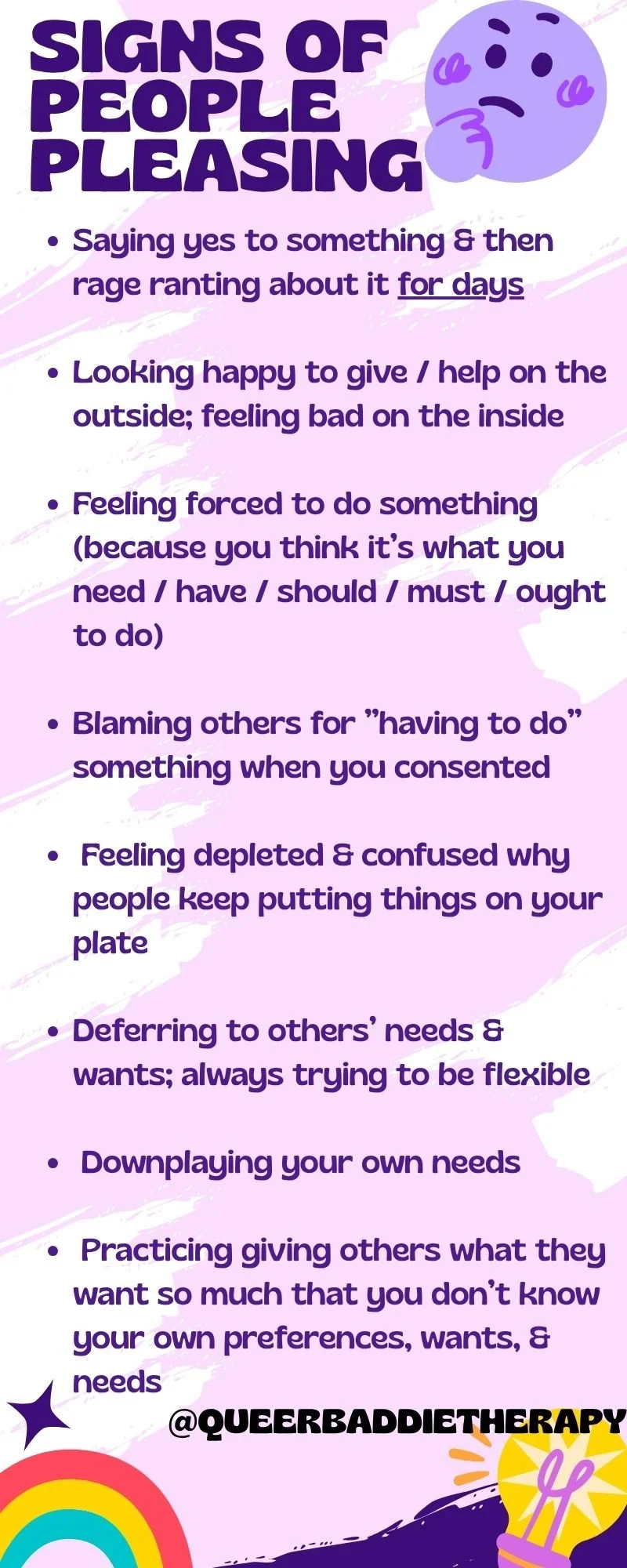
Psssst! ^Pin me^ for later reference!
People pleasing in relationships
People pleasing happens in relationships because that’s where all humans learned to people please. On the one hand, helping others can be wonderful. On the other hand, it can mean that our needs get left behind while we neverendingly prioritize others’ needs and/or wants.
What causes people pleasing?
Just like I was saying above, it’s likely that all of us will people please at some point. Inevitably in life, we’ll get into a context where it’s socially sensical to help others even when it inconveniences ourselves. But we have to keep an eye on why and how frequently we’re choosing to do so. If you find that you repeatedly serve others’ needs before your own, it’s more likely that you have people pleasing trauma origins. Fawning trauma responses are well practiced before becoming automatic, so the more you people please, the more likely it is that you’ve had to practice people pleasing. As for the “why,” I’ll loop back to the insight of Hailey Magee, who says that when we people please, we’re choosing to prioritize others out of fear (“I’m afraid of what will happen if I don’t”), transaction (“I give you _____ so you give me [safety, attention, love, etc.]”), loss aversion (“I’m doing this because I’m afraid I’ll lose you if I don’t”), or obligation (“I’m doing this to avoid feeling guilty”). This differs from meeting others’ needs out of kindness, which would mean that we have an intrinsic desire to help someone, and that we also know we can say no or yes to the request.

Can I learn to stop people pleasing?
Yes, of course! It can be deeply uncomfortable work, but it’s entirely possible. Being able to stop people pleasing will take concerted effort to change the underlying behavior and thought patterns that lead to it. For those with trauma history as the origin of their people pleasing, stopping it may also require trauma healing work.
Pleasing People vs Pleasing Yourself
As a licensed therapist, one of the things I like to point out to people is that there is a shadow side to people pleasing. Namely: that when we focus on pleasing others, it means that we don’t focus on pleasing ourselves. If we do that here and there, that’s not a big problem. Doing it as the modus operandi though? BIG problem. What ends up happening is that our brain creates stories of why we must be choosing to people please. Those stories typically include blaming others and ourselves, which means our relationships suffer, and our self esteem does too. Think of it this way: when we prioritize others’ needs above our own, we say yes to them, which could mean we’re saying no to ourselves. Do it enough, and we end up hating everyone, and perpetually pissed about the state of society (because “I can’t believe anyone would do/ask for what they did. UGH I hate people”), not to mention chronically overwhelmed. Yikes.
People Pleasing/Fawning FAQs
-
Individual therapy will help you learn how to set boundaries, and otherwise change your behavior by helping you identify what’s led to people pleasing thus far. Once you have that knowledge, you’ll have the power to change your behavior. If you have people pleasing that’s rooted in trauma origins, individual therapy with a trauma-specialized provider can also help you heal from trauma alongside helping you gain new boundary skills and changing your behaviors.
-
Let’s be honest; probably! But if we follow through with the work, it’s likely to be a whole heck of a lot less than before therapy. Like I’ve been saying in this article: at some point in life, it’s likely we’ll all people please. That includes post-therapy. Doing so every so often isn’t likely to lead to big harm in life. It’s all in the “why” and the “how frequently” that it gets problematic.
-
Yes! It might be that you’ve been trying to change your behavior without the adequate support. Which is totally changeable! Often, when I see people growing out of people pleasing, they struggle with falling back into previously practiced behaviors. This can be so frustrating that, without support, people give up entirely. But with support, those frustrations are less likely to result in giving up. Especially if that support is from a trauma-specialized therapist who can help you make sense of what’s going on, teach you how to regulate through the distress it causes, and help heal the impact of contributing trauma. Therapist support can also include support in communication skill building, helping remember progress, and keeping your mindsets productive for the work. For example, when setbacks happen, I like to tell people that those setbacks are great sources of data; they give the opportunity to assess what’s been happening, and why. How we respond to them makes all the difference when it comes to our odds of success. If we get defeated and hopeless, there will be no change… because we won’t be able to make sense of what’s occurring and why. Which also means we won’t get the chance to try out new behavior. Whereas if we stay curious and cautiously optimistic, our success is inevitable.
-
If saying yes to them is saying no to me, then that’s gunna be a no from me.
No one can take care of me better than I can.
Don’t cross oceans for people who won’t jump puddles for you.
Don’t set yourself on fire to keep others warm, it just burns you out. Then they’ll be cold anyway.
Be more afraid of losing yourself than other people.
How to stop people pleasing: Conclusion
And with that, I’m glad to say you can stop scrolling, officially! We’ve covered what people pleasing and fawning are, what causes them, why stopping them can be so hard, and that learning how to stop people pleasing is something that takes self reflection, practice, and sometimes, specialized support. If you’re someone who’s struggling to kick the people pleasing habit and are looking for support from a trauma-specialized provider licensed to work with folx in Oregon, California, or Montana, reach out to me to book your consultation call today! I’d be honored to support you through the setbacks and skillbuilding!