How to Calm Your Nervous System: Tips From a Therapist
Ever get stuck in fight or flight? If you have, you know just how challenging it can be. It takes up precious time, and is exhausting. Well wait no longer! I’m a licensed therapist with fifteen years of clinical experience, and I’m happy to teach you how to calm your nervous system, so you can get out of fight or flight fast as humanly possible. In order to teach you what you need to know, we need to learn a little biology (specifically about the nervous system and stress responses–don’t worry, there’s no pop quiz!), and then we can get practical with our interventions. Let’s dive in!
The Nervous System

Why’s it gotta be nervous??
All jokes aside, the human nervous system is a very important and practical thing. Think of it like your body’s command center. It includes your brain, spinal cord, and nerves. As the Cleveland Clinic describes, “Your nervous system works by sending messages, or electrical signals, between your brain and all the other parts of your body. These signals tell you to breathe, move, speak, and see… Your nervous system keeps track of what’s going on inside and outside of your body and decides how to respond to any situation you’re in.” All that to say, sometimes as we go about our lives, we will be in situations that are dangerous to our wellbeing. When those situations occur, the nervous system kicks off one of the stress responses to ensure our best odds of staying healthy, safe, and alive.
Types of Stress Responses
As it currently stands, experts have highlighted six stress responses of the human mindbody system. We’ll unpack them all below.
Fight or Flight
These are the classics. The fight response is kicked off when our stressor seems best managed by scrappy measures–something we can fight off. Flight happens when our stressor is best managed by running away.
Freeze and Faint
Freeze happens when the stressor is best managed by remaining still and/or hidden. Or, if the experience is so stressful that your mindbody system determines that it’s best to not experience it at all, that results in a faint.
Fawn and Fine
Fawn and Fine are responses which include a social component. In the case of fawn, we’re opting to placate, humor, or otherwise defer to someone(s)/institutions/forces that have more power or resources. Fawn responses can happen before, during, and after stressful events, and are attempts at keeping the peace. Fine responses happen after a stressor has concluded, and essentially, are a state of denial about the stressor. During this response, it’s common to see people convince themselves that their situation isn’t that bad, question whether it even happened, and/or pretend that it didn’t happen at all. Folx may still feel big emotions (anger, grief, etc.) on the inside, despite appearing calm, in control, and possibly even happy on the outside. Especially if there’s social pressure to appear fine. Fine responses are a sign that whatever happened was too big for the person to handle all at once, so their mindbody system opted to slow things down.
How to Calm an Overactive Sympathetic Nervous System Response
You may have noticed that the stress responses above are great for managing some kinds of stressors, but not all stressors. This is as a result of how the human mindbody system has evolved over time. In essence, the human mindbody system has been trained by the stress experiences of historic humans, and as such, it’s much more helpful for managing stressors that are similar to those of historic humans. Unfortunately for us modern humans, that means that our mindbody systems are still trying to catch up with our modern stressors. For now, our nervous system kicks off stress responses for a modern stressor (like, say: making sure we make enough money to keep the lights on) in the same way it would for a stressor more like a historic human would have (like: responding to a predator animal in the wild).

Sympathetic and Parasympathetic Nervous System Responses
While a lot could be said about nervous system responses, and their intricacies, I’ll boil it down to the basics so readers don’t feel like they got unceremoniously chucked into a class on neurobiology. Here’s the jist– in clinical jargon, we call the kicking off a stress response an activation of the sympathetic nervous system response. The powering down of a stress response is referred to as an activation of the parasympathetic nervous system response.
The Vagus Nerve
Now here’s the fun, helpful part: the Vagus Nerve, which is the longest running nerve in the human body, can be utilized to help power down a sympathetic nervous system response (aka that fight, flight, freeze, faint, fawn, fine). It can do that because of its amazing functionality to send status checks from the brain to the vital organs (of which it connects to juuuust about every one). AND it can do that on demand; you just have to know how to kick off the status checks. Spoiler alert: stay tuned, we’re going to get to that soon.
Trauma Leads to an Overactive Sympathetic Nervous System Response on the Regular
Now the not so fun bit: the human system can flip into so many stress responses that it gets really strengthed at kicking them off. As a result, humans can get stuck in stress responses for much longer than is actually helpful for stress management. That’s especially the case for those of us who have been through several many instances of trauma (hellooooo CPTSD). This makes our nervous system overactive and/or sensitive. So much so that even things that aren’t actually dangerous can still set off a stress response. Ever walk past a car and its alarm goes off despite you being no less than four feet away? Ya, it’s kinda like that.
Exercises for the Vagus Nerve
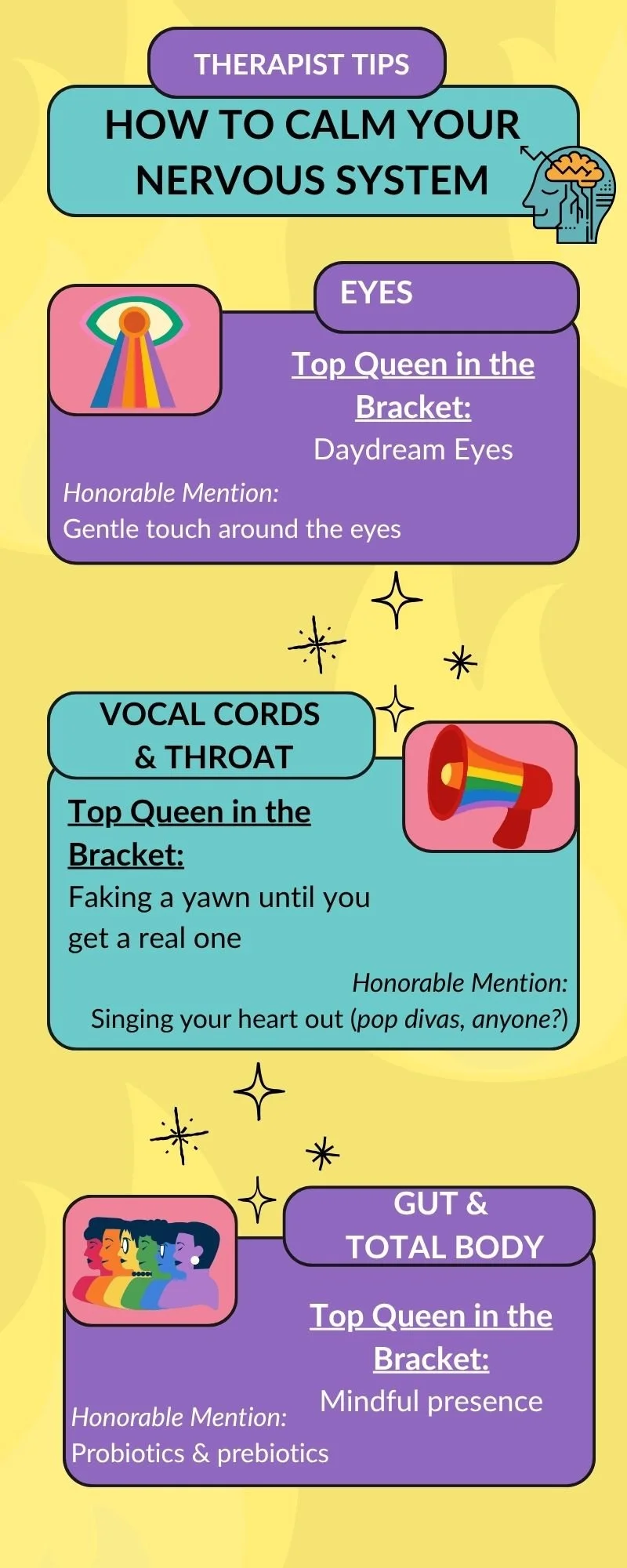
So what are these wonderful exercises? You know, the ones that can end the stress response? Well, the good news is that there are many. Because the Vagus Nerve runs from the brain to the gut, we have lots of points along its path to interact with it and get those status checks sent out. I’ll cover my favorites below.
Psssst! ^Save me^ for easy reference on the go!
Eyes:
Top Queen in the Bracket- Daydream Eyes. For this exercise, you’ll adopt the eye posture of daydreaming. The one where vision is hazy in the center, and you almost have more clarity of vision in the periphery. Queer baddie therapist bonus points if you let yourself daydream something delightfully queer AF too.
Honorable Mention- gently touching around the eyes. If you’re like me, and your hands run cold, even better! I say that because when humans are in a stress response, they have a tendency to run hot; because the most common stress responses cause elevated heart and breathing rates. Cold tells the overheated body that it’s okay to power down/rest. But beware: if you’re already cold, stay away from giving yourself more cold. It’s likely a sign that you’re not in one of the stress responses that elevates your heart and breathing rates, so it won’t help.
Vocal Cords/Throat:
Top Queen in the Bracket- Especially if you’re a former theatre kid like yours truly, try bringing back a classic; faking a yawn until you get a real one. It tells the body the time to rest is now. Works like a charm.
Honorable Mention- Singing your heart out to a few songs in a row that honor your feels. Angry? Get out the playlist of distracks. Sad beyond belief? Play some Renee (Rapp, of course; or whichever other of the divas you stan).
Pssst: Literally anything that moves the vocal cords for at least a few minutes at a time will work. Think: chanting, humming, gargling, laughing, etc. This bracket is probably my favorite because of how wideranging it can be.
Gut & Total Body:
Top Queen in the Bracket - Anything that forces your attention to the present: yoga, and mindfulness, and grounding, oh my! The trick here is the same: focus on just the present for long enough and the mindbody will stop kicking off the stress response because it can only focus on so many things at once.
Honorable Mention - Probiotics and prebiotics. The more we study gut health, the more we realized how tied it is to mental health. So talk to your physical health care provider and/or nutritionist about how to implement probiotics and prebiotics into your diet. It’s likely to get you closer to a better baseline of mental health day over day.
How do I know when these exercises working?
You’ll get a sign from the mindbody system that it’s powering down into the parasympathetic nervous system response. Those signs are: yawns, sighs, and swallows. All signs that the body no longer needs to activate to manage a stressor, and instead, is all clear for resting and digesting. You know, things that are absolutely not appropriate when managing a life altering stressor.
How to Calm Your Nervous System FAQs
Can I stimulate the Vagus Nerve naturally?
Abso-freaking-lutely! There are many exercises which involve interacting with the eyes, vocal cords/throat, gut, and other areas of the body that do exactly that.
Do I need to buy anything for stimulating the Vagus Nerve naturally?
Nope! At least, not unless you want to. There are devices that can be used to stimulate the Vagus Nerve, as well as supplies (think: oils that can be used for belly massage or yoga mats to get your flow on), but they’re not mandatory for stimulating the Vagus Nerve.
Do Vagus Nerve exercises work for an overly active Vagus Nerve?
Yes! In fact, if you do Vagus Nerve exercises regularly, you can retrain your nervous system back to it’s original functioning. No more sensitive car alarm-style firing!
What exercises for the Vagus Nerve will work best for me?
A wonderful question, for which I have a highly therapist answer. That depends. You’re going to need to play around with options to see what works best for you. Mindbody systems are wonderfully unique person-by-person, so playing around to see what suits you will be best. The good news? There are plenty of options and trying them out can even be fun!
Calming Your Nervous System; Conclusion
And there you have it! Now you know some of my favorite ways to exercise the Vagus Nerve for the purpose of calming your nervous system. All of the options in this article stimulate the Vagus Nerve naturally, so they’re safe to use to calm your nervous system, including for folx who’ve lived through complex trauma. If you’ve been trying to figure out how to calm an overactive sympathetic nervous system after years of trauma, these will get you going on the right path. As a licensed therapist, I’ve seen the exercises I shared here work wonders for folx of many kinds. Give them a try and see how they work for you! Don’t be afraid to try them all to see what works best for your wonderfully unique mindbody system.
Looking for even more Vagus Nerve exercise options? Join my email list below, and I’ll drop even more ways to naturally stimulate the Vagus Nerve in upcoming outreach. Plus, I’ll share even more tips, tricks, and tea about trauma treatment. Looking forward to connecting more soon!